

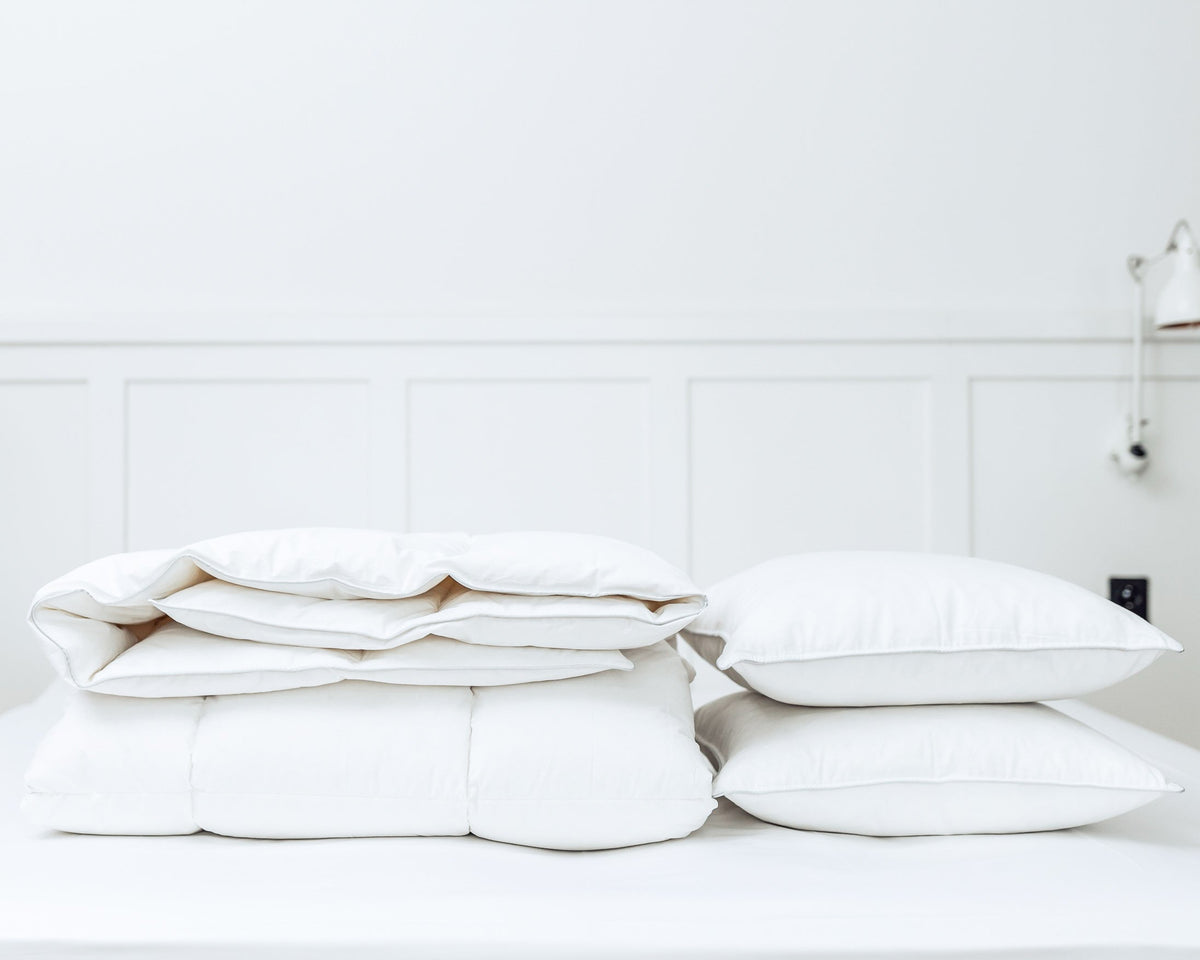
A good duvet is with you every night. Whether down or synthetic suits you better depends on what you want in terms of material, warmth and care. Marso Living offers both fillings in a light and a medium-warm version. The decision therefore starts with you and how you sleep.
What is the difference?
Down is an animal filling. Its fine structure forms airy pockets that help with insulation. Synthetic fillings consist of man-made fibres. For our Synthetic Duvet we use polyester as a down-free alternative.
| Choice | Down Duvet | Synthetic Duvet |
|---|---|---|
| Filling | European down | Polyester |
| Material preference | Natural animal filling | Down-free, vegan filling |
| Warmth levels at Marso Living | Light and medium-warm | Light and medium-warm |
| Care at Marso Living | Max. 60 °C, delicate cycle | Max. 40 °C, delicate cycle |
| Origin | Made in Switzerland | Made in Switzerland |
When does down suit you?
Our Down Duvet combines a filling of European down with a cotton sateen shell. It suits you if you are looking for airy fullness and a natural filling. How our duvets are made is explained in Made in Switzerland.
For our down products we use DOWNPASS-certified down and feathers from controlled and traceable supply chains. This is a separate aspect of the choice of material. Information on testing for harmful substances can be found separately under OEKO-TEX® STANDARD 100. What the label means is explained in DOWNPASS explained.
When does synthetic suit you?
Our Synthetic Duvet is a soft, down-free alternative. It particularly suits people who deliberately want to avoid animal fillings. Here too, you can choose between light and medium-warm.
If you have an allergy, the specific trigger determines what suits you. A synthetic duvet alone does not solve a house dust mite allergy, for example. Check the material, the care label and the washing temperature you need; if in doubt, seek professional advice. According to our product care guidelines, the maximum temperature for our synthetic duvets and pillows is 40 °C. More on this in our guide Duvets and house dust allergy.
The filling is only part of the decision
A down duvet does not have to be especially warm, and a synthetic duvet does not have to be especially light. Construction, fill weight and warmth level also matter. If you get warm quickly, a light version is worth looking at first. If you tend to feel cold, a medium-warm version may suit you better.
Size matters too: your duvet should cover you well, and the cover must have the same dimensions. If you use two separate duvets, each person can choose the warmth level independently. For children there are separate sizes in our junior bedding.
Washing and drying
We recommend washing duvets about twice a year. According to our care instructions, down duvets and pillows can be washed at max. 60 °C, synthetic ones at max. 40 °C on a delicate cycle. The care label always takes priority.
Both need enough space in the washing machine and tumble dryer. Dry completely at a low temperature and shake the duvet in between. For down we recommend wool dryer balls. Only use and store the duvet once the filling is dry too.
Your decision in three questions
- Would you like a natural animal filling or a down-free one?
- Do you get warm quickly at night, or do you tend to feel cold?
- Do the washing temperature and drying fit your everyday life?
Both duvets are also available as a bedding set with a matching pillow – with the set you save 10 %: the Down Bedding Set and the Synthetic Bedding Set.
Discover our duvets and the full product care instructions.
Share:
Linen or sateen? Which bed linen suits you?
Which duvet for which season? Light or medium-warm