

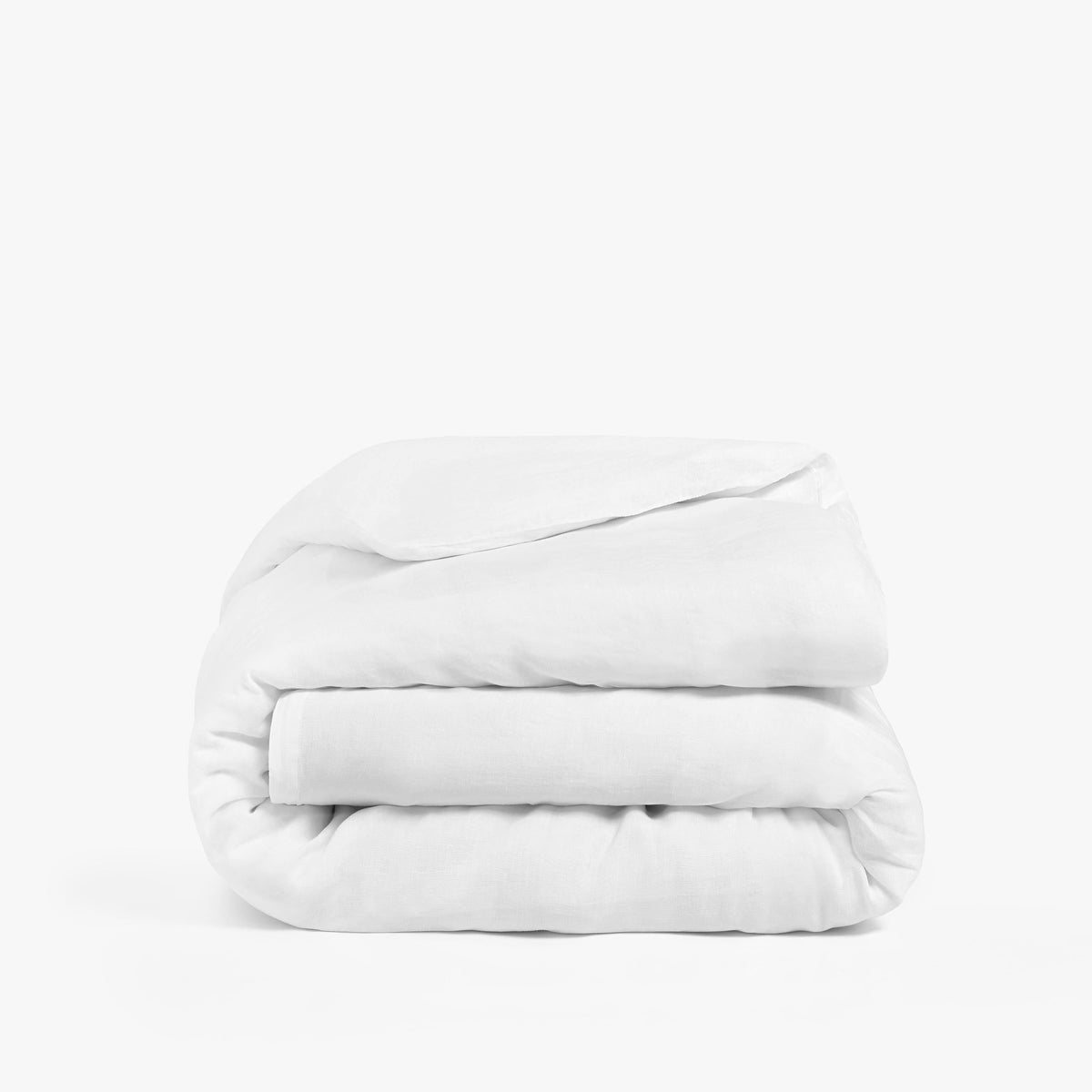
For many people, putting a cover on the duvet is one of the least popular household tasks. You half disappear into the cover, search for the corners and shake until your arms are tired. With the right sequence it is much easier.
We show you two methods that work well in everyday family life. Both can be done alone and take only a few minutes.
Before you start
Check briefly that duvet and cover have the same dimensions. A 200 × 210 cm duvet needs a 200 × 210 cm cover. Our Sateen Duvet Cover comes in 160 × 210, 200 × 210 and 240 × 220 cm, our Linen Duvet Cover in 160 × 210 and 200 × 210 cm.
Shake the duvet first so that the filling is evenly distributed. Then lay it flat on the bed.
Turn the cover inside out
Open the zip fully. Our duvet covers have a concealed zip. Then reach into the cover and take hold of the two top corners from the inside.
Hold the corners and let the cover drop down over your hands. It is now inside out, and your hands are in the corners.
Grab the corners, pull in the duvet
With your hands in the corners of the cover, take hold of the two top corners of the duvet. Hold each cover corner and duvet corner firmly together.
Now lift both and shake firmly. The cover slides down over the duvet by itself. With large duvets it helps to kneel on the bed or put the duvet over one shoulder.
Lay the duvet down, pull the cover down at the sides and line up the bottom corners. The first part is done.
The roll method
The roll method is also known as the burrito method. It works especially well if you have little room to shake or are covering a large duvet.
- Turn the cover inside out and lay it flat on the bed. The opening faces the foot end.
- Lay the duvet flat on top of the cover. The edges lie exactly on top of each other.
- Roll both up tightly together from the head end to the foot end.
- Now turn the opening of the cover around the roll, first at one end, then at the other.
- Close the zip part of the way and unroll everything back towards the head end.
As you unroll, the cover turns right side out by itself. The duvet is now inside.
Close the zip and shake out
Close the zip fully. Because it is concealed, it is barely noticeable once the bed is made.
Finally, take the duvet by the two top corners and shake it out once more. This spreads the filling evenly in the cover. Then lay it on the bed and line up the edges.
Pillowcase with hotel closure
Our sateen and linen pillowcases have a hotel closure on the back. This is a folded-in fabric flap that holds the pillow in the case.
This is the easiest way: fold the pillow lightly lengthways and push it into the far corners. Then let it unfold inside the case. Finally, tuck the corners of the pillow under the flap. No buttons or zip are needed.
If it does not work
If the duvet sits crooked in the cover, open the zip a little. Reach through the opening to the corner that has slipped and pull it into place. Then shake out briefly once more.
If a bulge forms at the foot end, the filling has usually shifted. Lay the duvet flat and spread the filling with both hands from the middle outwards.
A few everyday tips
- Close the cover for washing: turn covers inside out before washing and close the zip. This helps the fabric keep its shape.
- Make the bed straight away: if you have two sets, you can make the bed fresh while the other set dries.
- Get the children involved: many children enjoy the shaking. With two people it goes even faster.
How often a change makes sense is explained in our guide How often should you change your bed linen?. You will find a complete set of duvet cover and two pillowcases in our Bed Linen Sets. In a set you save 10 % compared with buying the items individually.
Frequently asked questions
Where is the zip on Marso Living covers?
Our sateen and linen duvet covers have a concealed zip.
Which method is faster?
The inside-out method is usually faster. The roll method needs less strength and suits large duvets well.
Do I need to wash the cover before first use?
That is your decision. When washing, follow the care label: our bed linen can be washed at up to 60 °C; we recommend 40 °C on a gentle cycle.

Share:
Pillow sizes in Switzerland: 50 × 70, 65 × 65 or 65 × 100?
DOWNPASS explained: what the label means for down